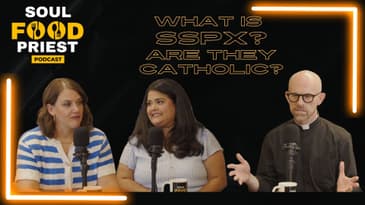
So many people are confused by what SSPX (the Society of St. Pius X) is. Now this society is in the news and Pope Leo has excommunicated their bishops and priest. Who are they? Were they Catholic? What do they teach? Fr. Ben discusses the answers to these questions in this episode with Silvia and Khira.
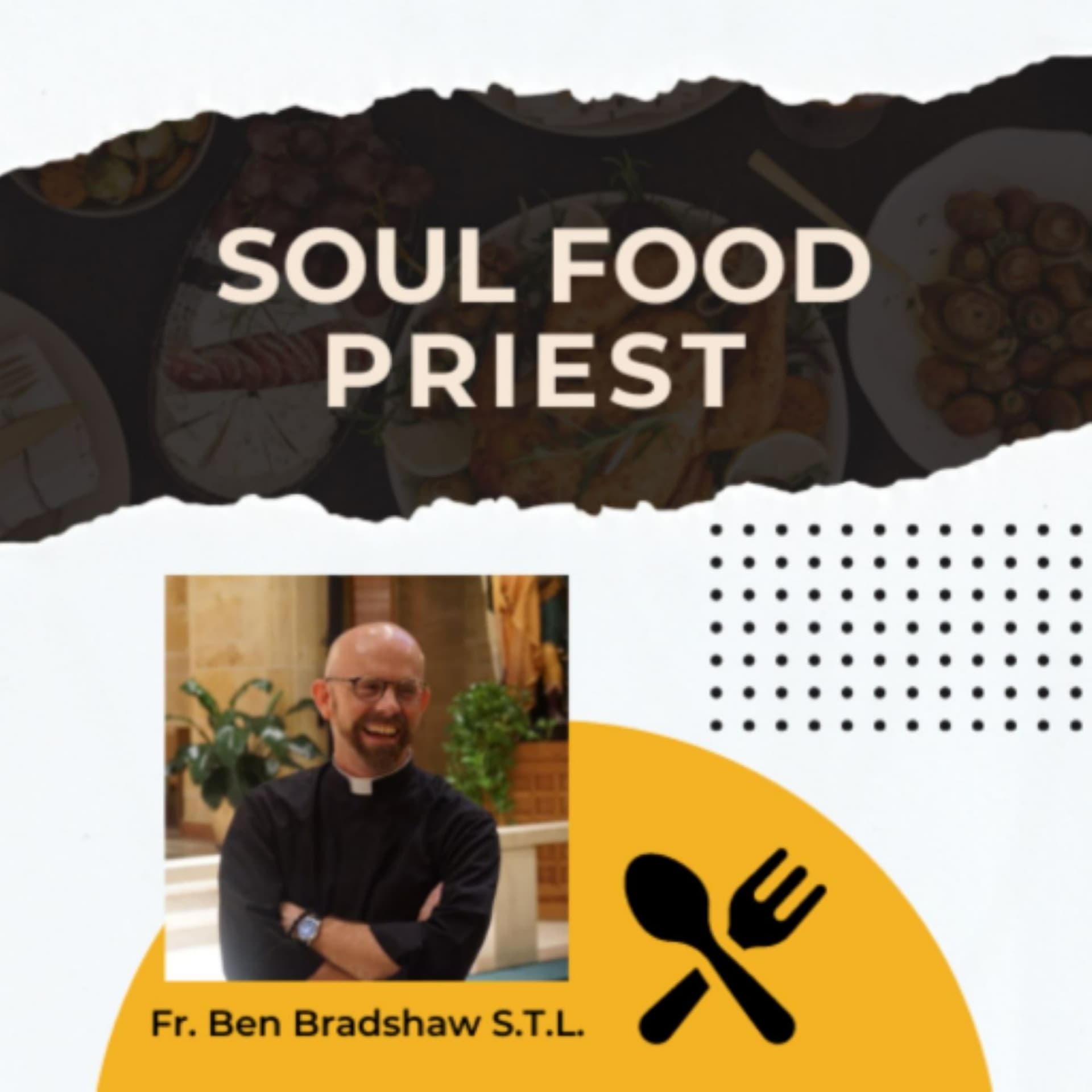
[00:00:01] Hey everybody, welcome to the Soul Food Priest podcast with Father Ben. It's wonderful as always to have you and I'm here with Kira and Sylvia. Hey guys. Hello. How's life? Good. Well, I'm a little sad. Why? You know, the World Cup is happening. A lot of our teams have come and gone and a lot of great teams are still out there. The Lord giveth and the Lord taketh away, Sylvia. Well, sometimes we hope that he just leaves it a little more and then takes it away later in the process. Yeah.
[00:00:28] But we'll be fine. It's a good thing. What is the, like when people go to, because I do love, I really do love soccer. I love it. But I never go to soccer games. Okay. Okay. And so when, like when people go to a soccer game in Mexico, what are they eating? I'm curious, like what food, like what's the national food that they would serve? Okay. Are you asking outside or inside?
[00:00:58] Like let's say you go to a stadium and a soccer. Okay. Outside of the stadium, you're going to have a bunch of stands. Like tailgating. And you're going to eat outside. You're going to have the street tacos, the tortas, the street stuff. Once you go in, you have the high end stuff. No one's really eating. They're just drinking. Okay. Okay. So they don't like, let's say I want to go, I want to go to, I want to go to a soccer game in Mexico City.
[00:01:24] And then I go and I want some churros. Can I buy some churros there? You know, I haven't been to Mexico City stadiums, but what I saw in the stadiums in like Monterrey stuff, you will have the lace chips and they would put like the Valentina on it and it would give you your beer or your Coca-Cola. Love it. Love it. So that's what you would have. Okay. And everyone's just like eating chips, different kinds of chips. So then you've got the peanuts. So it's like the guy with the snacks.
[00:01:53] So you can get peanuts too. Peanuts and like the different kinds of leis. Okay. And the chicharrones. Oh, I love chicharron. Those who may not know chicharron are what? Pig skin. A pig, what is it? Like pork rinds. Pork rinds. Yeah. It's one of my favorite things in the whole wide world. Mm-hmm. No carbs. Love it. No carbs. Yeah. It's good. Now in the US, you know, we have, you know, the World Cup going on. Yeah. You find all kinds of food during the FIFA thing.
[00:02:21] People are complaining that everything is so high end and expensive that they just rather eat before the game because they have like high end food. Yeah. Honestly, I would have loved to have tried it. The England-Mexico game? It's just not. Sorry. That was, it's too recent. I know. I'm so sorry. It's too recent. But the point that I'm making, obviously they had a lot more drinking going on in that stadium because like at the end of the game, there was an Englishman. No shirt on.
[00:02:49] Had the red and the white here on his face and a big Mexican sombrero on his head. I love it. I love it. I love it. That's community coming together. That there's cultures. Korean people. Lots of tequila and cultures. I believe it. Korea were like, we don't want to leave. I love it. Yeah. Mexicans embraced Korea so much to the point where they were throwing them up in the air. Mm-mm. And like, Koreanos, ya eres Mexicano. Mm-mm. Koreans, you are now Mexican. Yeah. And throwing them up in the air. Oh. Just community.
[00:03:19] That's awesome, man. And the Scottish, they, I mean, Boston ran out of beer. Yeah. Because the Scottish, they have something dry. That I believe. They have something dry. Anybody that's been to Scotland will have no problem believing that one. Erin, you know, for any American city that you would think would have enough beer, it would be Boston. You'd think. But no. Yeah. But the Scottish though, they're like, if you come to Scotland and you say you're from Boston. Yeah. You are going to be treated so well because we love you guys. Like it's. Yeah. It's really kind of, it's a beautiful thing. It's just bringing all the world together.
[00:03:49] And it's just a beautiful thing. Yeah. It's a, it's a beautiful, beautiful thing. At the end of every game, I mean, people that have been rivals. Mm-mm. And you know, before the game, they were talking snack about each other. And they just, at the end, just hugging each other out. You know? Yeah. Well, the closer we get though. I am a little worried because the closer we get and the more intense it gets, the higher the stakes go. Ooh. Yeah. Norway. I'm thinking Norway's going to take it. You think so? I think Norway.
[00:04:15] I told you guys about the, the culinary Olympics that they have. You did. Tell us a little bit more. Yeah. So in the year 1900, they founded the culinary Olympics, which they have every four years as well. And in Germany. And they have, if I'm not mistaken, 60 countries that come. And they have like, I mean, it is brutal. They have a kitchen. You can pull this up on YouTube. All their kitchens are little glass pods.
[00:04:42] And so you can go up literally this close to them and watch what they're doing. Mm-hmm. But they have like, judges on them like a hawk. Oh, I couldn't. And so. I would probably mess up because of that. Yeah. Man, it is brutal. Would you ever do that? No, I would never want to do it. But I, I have done like culinary competitions, but I have, um, I would love to go and watch. Yeah. I'd love to go. So, so the next one I think is in Frankfurt, maybe. I can't remember.
[00:05:11] In 2028. And so I would love to go, but it's kind of similar like FIFA. That'll be fun though. Yeah. Yeah. Yeah. Cause that's what I was, that's what I was actually saying today was like you, the best teams are the ones that they're skilled. They work well together. They communicate well together. They know their, their teammate is there. You've got strong guys who are going to lead it, but they're also in those intense
[00:05:38] moments and those intense times, they don't freak out and let fear kick in and start grasping and get scrappy. Yeah. Instead they're able to kind of keep a level head and do what they do well. And I, I mean, it sounds like what you have to do with the cooking Olympics too, is like fear could easily creep in. 100%. Yeah. In that. And, and, and in my brain, in my mind, it could creep in and it could start taking over and then you freak out and then you start grasping. Yeah.
[00:06:06] Or they learn how to, they learn how to channel it because it can actually make one better. I mean, there's a healthy sense of, of channeling it in a sense that it, which you see in people in the military too. I mean like special forces kind of talk about some of that stuff. Yeah. And so, yeah, yeah. It's, it's cool stuff. And one of the things that I love about it is it brings unity.
[00:06:32] And like one of the, one of the things that has been in the news a lot as of late is disunity. Mm-hmm. And one of the things that Pope, our current Pope, his motto is it's, it's like the exact wording of it, I can't remember, but it's like basically Lord let them be one as we are one. Mm-hmm. And so it's about unity. Leo's motto. Leo's motto.
[00:06:58] And, and so one of the things we can imagine that was so painful for him was when they had, during the recent excommunications of, of the bishops with the Society of St. Pius X. And for those who may not know, there's been a lot in the media about this, but in 1988, there was a man named Archbishop Marcel Lefebvre who was, who actually knew Joseph Ratzinger
[00:07:26] Benedict XVI and Carol Voitia with John Paul II at Vatican II in 1962, 1965. So Archbishop Lefebvre rejected, even though he's at the council, he rejected the council, which we're not allowed to do as Catholics. And he specifically rejected the document on religious freedom and what's called Gaudium et spes, which John Paul II worked very, very closely in both those documents.
[00:07:56] So, so he kind of split, he split and, and started this, the Society of St. Pius X, which ironically were Pius X alive today, would have a lot of not pleasant things to say about, about that. But, but, but, so he, in 1988, he, him and several other bishops consecrated other bishops without the Pope's approval.
[00:08:26] You can't do that. That's a huge no-no. So it's what's called latte sententia excommunications. It's, it's, it's, it's immediate. Right. Mm-hmm. And, and it would be like a priest announcing from the pulpit something they heard in confession. Mm-hmm. Right. It's, it's, it's immediate. Yeah. And so John Paul sent Joseph Ratzinger, who was then the head of what's called CDF,
[00:08:52] the Congregation for the Doctrine of the Faith, to a cone Switzerland, to talk to Lefebvre, Archbishop Lefebvre, saying, please do not do this. Please don't do this. Mm-hmm. And at his face, the Archbishop agreed. And then soon as Cardinal Ratzinger left, he changed his mind and went back. They did it. He was excommunicated along with Bernard Fillet, who later headed up the community after Lefebvre's death.
[00:09:20] He died in 1991 in a state of excommunication. And so what we see, that was what, 38 years ago. And here we are, same thing happened. Yeah. Same thing happened. And so, uh, Pope Leo called, you know, called them the day before, please don't do this. Please, please don't do this. Because it's not just about you. Um, Jesus has very, very, very strong words.
[00:09:47] He says, um, those of you that would lead one of these little ones astray, it's better than a millstone thrown around your neck and you're thrown into the sea. Mm-hmm. So, the blind leading the blind, he says in another place, right? In other words, it's not just about you, right? Okay. I'm gonna hold you responsible for how you lead these people. Mm-hmm. And at the end of the day, people hear what they want to hear. Yeah. And so this is, um, it's a really, uh, sad, uh, scenario.
[00:10:17] Mm-hmm. I mean, it's all, it's, that's why we pray for unity. Mm-hmm. And that people, um, people realize that as St. Augustine said, uh, many, many times, he was dealing with multiple heresies at the time. The Donatist heresy and Pelagianism, right? Mm-hmm. And he said, he said, where Peter is, there is the church. Mm-hmm. Right?
[00:10:42] And other church fathers said that too, but, you know, St. Augustine also said, Peter has spoken, the matter is settled. Yeah. Mm-hmm. So in other words, you have, uh, the Vicar of Christ, at the end of the day, we either believe that the Pope is or isn't. Yeah. That he, the office he holds, even if he himself is not perfect, he holds the office, the keys of Peter. Mm-hmm.
[00:11:08] And so, um, so that's why we, that's why we stand with him. Mm-hmm. And, uh, we may not always agree with him on different things. On the other hand, uh, he, the Holy Spirit works through his office. Mm-hmm. And that, it's never, ever good to, when one separates oneself in a state of schism, uh, as the, uh, I mean, that was the word that the Holy See has used with regards to this. Mm-hmm. So, um, so we just pray.
[00:11:38] Yeah. Yeah. And we're, just to, just to clarify in case anybody is, is listening for, in, isn't totally sure about what recently happened. Yeah. So where was it that these, that these bishops were quote unquote ordained bishops by the Society of St. Pius X X? So it took place in a cone, Switzerland. Mm-hmm. Right? In an open field. Mm-hmm.
[00:12:01] And so, um, in order for, in order for, uh, and again, this is not coming from Father Ben, this is what our faith teaches us. This is in canon law. This is in Catholic doctrine. Mm-hmm. Um, so, um, this is what Catholics believe. So in order for, uh, any of the sacraments to be, to count. Mm-hmm. Yeah. For the Sunday obligation or a wedding or confession, we need two things.
[00:12:29] Uh, legitimate, uh, holy orders. Yeah. Okay? And they have to be in union with Rome. Mm-hmm. Apostolic succession. So they have valid holy orders, but they're not in union with Rome. Mm-hmm. Okay? So for instance, if I were to leave the priesthood. Yeah. And go to, and let's say I open Father Ben's church. Mm-hmm. In my house. Okay? Mm-hmm. Uh, I could have mass here, but it doesn't count. Yeah. Yeah. It's a, I'm not in union with Rome. Mm-hmm. Okay?
[00:12:59] And so, um, way back in 1985, um, um, Joseph Ratzinger, Bennett, the 16th, wrote a book called The Ratzinger Report. Mm-hmm. Which was the catalyst for them to write the Catechism of the Catholic Church that came out seven years later. Mm-hmm. But in The Ratzinger Report, he talks specifically about Archbishop Marcel Lefebvre. I mean, this is 1985. Mm-hmm. Yeah.
[00:13:26] And so, that's how long we've been- Yeah. Yeah. Yeah. And so, um, so yeah, they have to, we have to not only have valid holy orders, uh, and matter and form, but also, they have to be in union with the church. Mm-hmm. Which they're not. Mm-hmm. Mm-hmm. And so, that's why, uh, Pope Leo said- Yeah. Their sacraments don't count. Yeah.
[00:13:54] I mean, so they, they, you have to have that. Mm-hmm. And, but you know, we need to be clear, the Pope here is not, he's, he, he really, really, really, really has tried to work with them. The church had for many, many years what's called the Ecclesia Dei Commission. Mm-hmm. That met with them under the Dicasterly, the Doctrine of the Faith. Mm-hmm. Really, really tried to meet them and, and work with them. Pope Benedict, for himself, lifted the excommunications. Mm-hmm.
[00:14:23] Tried to make the Latin Mass much more accessible. So they, they really have tried to meet them. Yeah. But there's some, there's a few non-negotiables that we have to believe. Right. And so, and so it, they really have tried. I mean, I'm, and that's why we're talking about unity, is that Leo, I really, really admire him because he's really, he really, really tried to work with them. Yeah. Yeah.
[00:14:51] And I think the, I think a point to make here too is a lot of people, kind of their mindset regarding the Pope can be like a tyrannical leader. Mm-hmm. Where it's like, oh, the Pope stated this. Now all Catholics have to, you know, have to believe this, you know, like, like blind faith. Yeah. Like, we just follow whatever he says. Right. And I think a lot of people in our culture and sometimes even in the church have that mindset.
[00:15:15] So whereas, and the, the proper mindset is, is, is they are bound to follow what Christ instituted. Yeah. And, and, and so as you said, Christ says, you know, if you, if you lead the least of these, it would be best for the millstone. So just like what you quoted, but in even St. Paul would even say, you know, like, even if you receive the Eucharist unworthily, you receive condemnation upon yourself.
[00:15:44] I mean, like these are big, big words with eternal consequences. Yeah. Not just, so, yeah, cause these are, the Pope is the shepherd of the shepherds and the shepherd of souls and our souls are eternal. So therefore they're not just going to just say things that are just like, oh, you know, you do you do whatever suits you here or whatever you want to do here. Right. And then maybe you'll learn your lesson.
[00:16:13] No, like this has eternal consequences and they are looking towards eternity and not just the here and now. That's right. And people often, I mean, usually human nature is such that they think I'm the exception of the rule. Like that applies to other people, but I'm the exception of the rule. I mean, it is, you brought up St. Paul. I mean, that's a good example.
[00:16:33] So in Galatians, for instance, we hear that Paul himself goes to confer with, with Cephas, with Peter to get his blessing. Yeah. And, and, and, and they didn't always agree. I mean, he, like, I mean, Paul was very clear at some point he had to do, and we hear about that in Galatians too. He, he had to do a little fraternal correction with Peter. Yeah. And with the, with the, the Gentiles. Mm-hmm.
[00:17:02] So like, we're not saying that the, the Pope is above correction. Right. Right. All we're saying is we admire his, we, we, we absolutely defer to his teaching authority in his office, which St. Paul did. Mm-hmm. He was like, look, I'm not the Pope. Mm-hmm. Mm-hmm. All right. Peter's the Pope. Yeah. Yeah. And so he goes and defers to his office.
[00:17:31] You know, then we hear, of course, the resurrection with morning on Easter morning. Mm-hmm. John the Apostle and Peter both, you know, they hear that Jesus is resurrected. They both run to the tomb after Mary Magdalene told him. Mm-hmm. And it said that John got to the tomb first. Mm-hmm. But did not go in. Mm-hmm. And Peter was older. He let Peter get there and Peter goes in first. Mm-hmm. And he, so he's deferring to Peter's authority. Yeah.
[00:18:00] And then of course in Acts 15 when they, with the council of Jerusalem, it's Peter who stood up. Mm-hmm. And said it seemed good unto us and unto the Holy Spirit that we should not impose this on the Gentiles. Yeah. Mm-hmm. It's Peter who gives really the first homily in the history of the Catholic Church on Pentecost Sunday. So there's, the, the, it's never good when someone separates oneself from apostolic succession.
[00:18:30] Mm-hmm. And because what happens then is you end up creating friction. And when we see this all throughout church history, not only friction, but also you end up leading people with you away from the Holy See. Yeah. Yeah. And it's not to say, I mean, in history we've had bad popes. Indeed. Mm-hmm. And, and praise God he raised up amazing saints in those times. Yeah. Yeah.
[00:18:58] To, to try to do, provide whatever correction needed to be made in, in those time periods and even, even approach and confront the popes themselves. Right. Or bishops or, you know, or priests, you know, religious. Yeah. But again, it's not, what you see about these great saints is they were, they were all about reform. And I've heard you say this too, they were about reform going back. Yeah.
[00:19:26] To, to the roots and not about total revolution. Yeah. That's right. And we're gonna, we're just gonna branch off because we completely disagree. Yeah. Like all the great saints were saying, we need to get back. We need to get back. Cause we're starting to allow the world's ways to interfere here and even our own pride and ego or thoughts or opinions. Um, and so always called back for a state of reform, but never a state of revolution. Yeah, that's right.
[00:19:52] And, uh, and so I think that that's, you know, that's, that's where we see the society going and has gone now is going in this revolutionary way. And, and as, as Catholics, we, we need to have, we have the humility to recognize, okay, yes, this, maybe this Pope, this priest, this Bishop may be steering in the, in the wrong way.
[00:20:19] That's the man, not the office, you know, that's the man, not the church and have taking place at that point. So we have hope in Christ and in his bride, the church and the Holy Spirit that they're gonna guide us, right? Even if we don't understand it. Um, but when they start, when somebody starts to take lead us into error with something that is completely contradictory to what Christ established, then, you know, you're not in accordance.
[00:20:49] That's exactly right. 100%. Yeah. Yeah. That's really true. You said it better than I was thinking. I'm like, I was, I was about to say that. No, yeah, that's really in my brain. When I, when I think about this, it's like, if you know, you are going back to basics, back to what the, you know, Jesus thought is, it should ring a bell that that's the right way to go.
[00:21:12] Obviously there's little tweaks that, you know, because of the, the world changes, but when you try to change doctrine and the beginning of the teachings, you know, that's when you start to think about, is that really the right way we're going? So if it's stuff like that, where you're trying to be revolutionary and change things, then stop for a second and really think about it. And that's really where I stand. I'm like, if you're going back to basics, why are we complaining? Yeah. This should be good.
[00:21:38] Yeah, there's, they have an expression, ecclesia semper reformanda, which means the church is always reforming itself, which ironically leads us to better and more wonderful growth. Yes. So when we go back to the roots, literally radix or radical, when we go back to our roots and our, our, our tradition, we grow more. Yeah. I mean, and so it's, in other words, it's not like we reverting. That's not what that means.
[00:22:08] Yeah. Refremanda. It means we've grown. Okay. Let's not forget where you came from. Yes. We've grown. Let's not forget where you came from. Beautifully said. Yeah. And so you see that with religious communities, for instance, when they go back constantly, constantly to the teachings of their founder or foundress. And, and it's, it's really beautiful. I mean, it's really, really beautiful.
[00:22:27] And I think I, I, I'm personally so elated with Leo and Pope Leo because he's, he's very Augustinian in his training and as was Joseph Ratzinger. And so they really have a sense of what we would call the climate of Ecclesia, right? Yeah. So in other words, the church and what the church needs.
[00:22:55] And, and I mean, he's got a rich, rich sense of that. I feel the Holy Spirit working around there. Yeah. So just, just very briefly, you and I taught a Vatican II class and, and you were talking a lot about Lefebvre. And one of the major documents that Lefebvre just, it just went crazy on. It was nuts. He just didn't like it.
[00:23:18] And so can you let people know like what exactly what it was about Dignitatis Humanae that really upset him and continues to live on to this day with regards to SSPX and, and the followers? Yeah. So Archbishop Lefebvre who founded SSPX, wrote, wrote a small book called I Accused the Council.
[00:23:43] And in his small book, it's, it, most of it is kind of directed towards Gaudium et Spes, the pastoral constitution, the church and the modern world. But he also addresses Dignitatis Humanae, the decree on religious freedom. So he did not like Dignitatis Humanae specifically because, for, for a number of reasons, but he thought it was altogether heretical.
[00:24:12] And one of the, the things that he believed is non-truth has no rights. So, so, so only, only those people that have the fullness of the truth would have the rights. It's, whereas like we would say, I mean, this is in our constitution, this is in our Declaration of Independence and the Catholic doctrine.
[00:24:36] Even if people are, want to be atheists or, or Buddhist or Hindu or whatever, they still have rights. Yeah. I mean, I was told people, you don't need a theology degree to know this. I mean, this is, I mean, they have rights as a child of God. Yeah. I mean, right? And, and so, but he did not like that. And, and it's the same way that in the Catholic world we believe the unborn have rights. Mm-hmm. Right? Well, Father, it's my body. No, actually it's somebody else's body in your body.
[00:25:06] Mm-hmm. And they have rights as, to exist. Yeah. Yeah. And part of those rights by virtue of one's dignity as having been made in God's image and likeness is that of religious freedom. Yeah. People should be able to choose what faith they want or don't want. We may not agree with them. Mm-hmm. But they have, that's, that's their dignity. Yeah. Right? And it's just, because love is a free will. Yeah. It's free will. I mean, it's just like, will you marry me? Mm-hmm. Yeah.
[00:25:36] You don't say, you will marry me. Mm-hmm. You say, will you marry me? Love is free will. Mm-hmm. And that's why at weddings, for instance, priests will ask, have you come here freely and without reservation to give yourselves to each other in marriage? Yeah. Nobody's twisting your arm. Right. And priests are asset of ordination. So it's, but yeah, that was a point of great consternation. Yeah.
[00:26:00] And I do think that, I do, I think that God is really gonna, in the coming years, raise up great saints, as he has in times of church history, to inspire people to really come back to the faith. Yeah. And to lead those that are still in it. Mm-hmm. So. I think it's already happening. I think so. I see a growth. Yeah.
[00:26:24] I mean, I see the church growing and I see the young coming back. Yeah. Indeed. As it, you know, years ago, it was really the older and the youth was kind of just lost a little bit or just like, I'm not sure. Mm-hmm. But I've seen a growth. So I, I think that's kind of what's happening. Vatican II, when implemented well, can do amazing things. Isn't that right? Isn't that right? Amen to that. Yeah. Well said. Well said. Yeah. It's cool stuff. It's funny.
[00:26:54] I'm the old man now. Like I go to do some of these things and I'm like, gosh, I need a walker, man. I need to take my teeth out. Holy mackerel. I'm like the old guy in the room. Amazing. I was playing volleyball this weekend and at the beach. Nope. And it started great. Really? It started great. This can't handle that. It started great up until, up until there was this movement that my body did that Sylvia
[00:27:23] can no longer do. Yeah. And it was like a, ugh. No. And I was like, okay, that's enough. Yep. I'm very, very good when people are playing volleyball. I'm very good about, I'm really good at eating spinach artichoke dip in the lodge, in the restaurant, watching. Yeah. Like I got that down. Yeah. See, it's in the summertime this year. I just went and sit down. We've got a whole group of friends in our neighborhood. No, no. Look. We have beach volleyball in our neighborhood.
[00:27:52] And we just invite all friends. We have a priest come over. We had a deacon come over. We had all these friends come over. Every Thursday we play beach volleyball. Now it's everybody around the same age though. Around. See, I was playing with youngsters. 30s and 40s. I was playing with teenagers. Well, we, my teenagers, they do, they do come in and, uh. No. Yeah, it's fun. Give it a few years, Kira. Cheers. Well, not cheers, but. God bless the church and its people.
[00:28:23] Amen. Don't forget to put soul in your food and give food to your soul. God bless you. Cheers. Well, now let's eat it. If you're dead, we're silent. Please do visit.