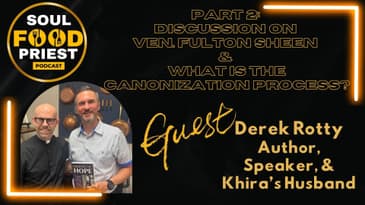
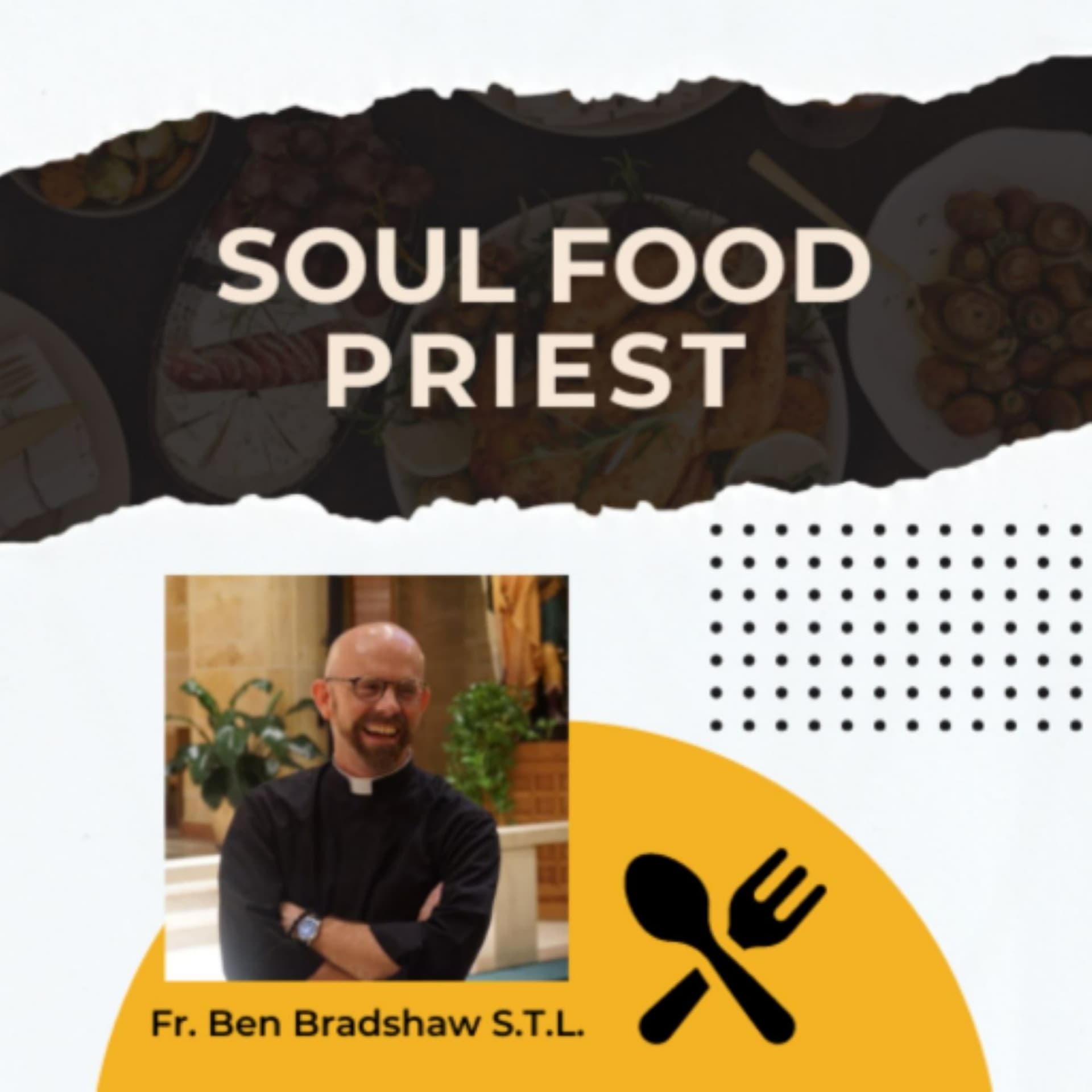
Fr. Ben continues his discussion with Derek Rotty on Ven. Fulton Sheen. They also address how a saint is canonized and what the process is like.
You can go to Amazon or the Our Sunday Visitor's website to purchase Derek's book: https://www.orderosv.com/product/prophet-of-hope-fulton-sheen-responds-to-the-modern-world.
If you're interested in the events surrounding Venerable Fulton Sheen's beatification, you can visit this website for more details: https://www.celebratesheen.com.
[00:00:00] Here we are. I think for those who may not know, when there is like a formal canonization, so they would usually have the prefect for the dicastery and the canonization of saints in Rome or one of his representatives to come and celebrate the mass in which they read a formal beatification.
[00:00:27] And people can be canonized outside of Rome, of course, but I think most people recognize the big tapestries that come down from the loggia at St. Peter's Basilica, right? So maybe one day. Maybe one day. Who knows, we might be cooking up a lobster bisque. I mean, exactly. For real. That's what Fr. Ben's stories about cooking up a lobster bisque.
[00:00:55] And then getting pulled away from it. But little did he know, he saw Edith Stein's canonization. Yeah, I was like, I was in the middle of a lobster bisque and I was like, he's like, and my friend Father Joe is like, we gotta go. I was like, no, we can't go. I'm not bisque. And he's like, dude, leave the bisque. And I was like, no, we can't go. And he's like, this is more important. And I was like, okay. And I was miserable pouting the whole time. And so now I'm like, okay, Edith, I guess you're worth it. You know?
[00:01:24] So one never knows. Did, do you know, like when he was in, because am I correct, Derek, he did his doctoral dissertation at Catholic U. He studied for a year at Catholic U. And Louvain. And then went to Louvain to finish. Okay. Did, what did he, do you know what he did his dissertation on? Like what? Yeah. St. Thomas and human knowledge, right? It's, I forget. St. Thomas Aquinas? Yes. St. Thomas Aquinas. Like epistemology.
[00:01:54] Epistemology. Yeah. I forget the exact title. It's in the book. It's, it actually became his first book, right? Okay. Or some, some distilled version of it. Mm-hmm. Became his first book in 1925, which, fascinating introduction written by G.K. Chesterton. Oh, no way. To that book. Yeah. Oh, wow. That's amazing. So, and yes, at Louvain. And one of the food stories or connections to food.
[00:02:22] So, he tells the story in his autobiography about the dissertation defense. And he says, when, you know, when the, when the graduates, when the people who were up for the defense, if you failed, you got water, was served to you afterwards. If you passed, wine was served to you. And if you passed with distinction, you were served champagne. Oh. And he doesn't say anything else except the next sentence is, the champagne tasted good that. Oh. You know.
[00:02:52] I love it. So that's one of the, you know, that's one of the, the, well, it must be true because he wrote it in his autobiography, right? Yeah. Is that Treasure and Clay? Treasure and Clay is the autobiography that came out just after he died. And it's a, it's a wonderful resource. It's a wonderful meditation because he goes through all the aspects of his life. And then it actually includes a beautiful picture of John Paul II embracing him right after John Paul II's election or shortly thereafter.
[00:03:21] And then before Sheen died in December of 1979. So there's this brief overlap and I can't remember where I read it if it's in the, if it's in the autobiography, but apparently John Paul whispered to him, you have, you have preached well. Oh, wow. Isn't that amazing? Yeah. Wow. What a good. And then it also includes Cardinal O'Meara's funeral homily. Oh, okay. From his, from his funeral mass. Was, was that at St. Patrick's? At St. Patrick's Cathedral. Okay.
[00:03:51] Gotcha. And yeah. That's amazing. Cause he died. Let's see. I want to get this right. He died in 79 on, I think on immaculate conception of a month. December 9th. 9th. Gotcha. So, and then Dorothy Day died a few months after that. And that time in March of 80 was when St. Oscar Romero was assassinated in El Salvador.
[00:04:16] So all three of them passing these pivotal Catholic figures at the same time. And of course we'll start waiting for the possibility of Dorothy Day's, uh, be application. Wow. So when, um, like as, as you kind of, uh, as, cause I'm sure I would imagine people like have been asking you more and more and there, they will be no question as, as this goes on. Sure.
[00:04:43] Like, um, do you, what, what do you think, what, what would be one of the main things like for people, for instance, that don't, they, like they've heard of Sheen. Mm-hmm. I've kind of seen him in passing drawing on the chalkboard and the old videos, right? Right. Right. So, what do you think would be one of the main reasons why he's pertinent to our times? Like that, that we could, what could people kind of take from his life? You laughed.
[00:05:09] I laughed because he has a sticker on his water bottle on a, and, uh, a friend of ours was like, is that Count Godoku? Oh yeah. I mean, he's got the, he's got the cape almost kind of. Oh yeah. I love it. I love it. But the bishops, you know, formal regalia and everything. And our friend was like, is that Count Dooku? Oh my gosh, no. It's a whole machine.
[00:05:35] But I mean, a lot of people did recognize him and notice him and kind of remember, cause part of his research too. I'm sorry, we'll get to you answering the question. But part of his research too, or part of his research too, or part of his research too, or part of his research too, I remember you contacted my aunt. Um, you know, he called my aunt and was like, what do you remember about Fulton Sheen when you were growing up? She was growing up at that time. He was a kid at that time. And, you know, she was like, I don't remember much, but my dad would watch him, you know? So he was, I mean, he was, he was there on NBC.
[00:06:04] Um, just, you know, preaching the gospel and the Catholic faith on NBC, you know, was it once a week or? Yeah. In that primetime spot. Yeah. The first season, the first full season. Which is incredible. I mean, that would never happen now. I was going to say, we would hope that would happen now.
[00:06:24] But, um, so a lot of people remember that, but, but nowadays, I mean, people who aren't familiar with him are like, oh yeah, he kind of looks like, you know, black and white and Dracula and kind of, you know, so. Yeah. Go ahead. Um, yeah, on that, uh, on that note, right? Um, that's, that's one of the things that he is remembered for. My, my grandmother, who's 93, when I told her about this project, she's like. And not Catholic. And not Catholic.
[00:06:52] She's like, oh, I remember, you know, that they didn't watch it as a family much or, or at all that I can recall her saying, but she knew of him in the 1950s. And, and she was, she was probably in her twenties at that point, starting a family. Um, anyway, so it, it, it's everywhere. Yeah. You know, I can't tell you the number of people I've talked to say, oh, I remember my dad had that on every Tuesday night. Incredible.
[00:07:20] And that's a funny thing is that they gave him that Tuesday night primetime slot because they thought it was going to die because it was right next to Milton Berle. Oh yeah. And he outdid Milton Berle in the 1950s. That's hilarious. He won the Emmy. And, um, that is so funny, but here's what I would say as, as far as a specific answer to your question is, um, you know, Sheen's message, um, was to engage the culture or his, his MO was to engage the culture.
[00:07:49] And this was again, a big question with, um, a Bishop on primetime television in Bishop regalia. Um, and then he wrote a newspaper column. He wrote a syndicated newspaper column for 30 years, weekly for 30 years. Wow. And it was never overtly Catholic. There was nothing in there that was not Catholic, but it wasn't, he, he never, in most cases, he wasn't preaching about, he wasn't, he knew he wasn't preaching to Catholics.
[00:08:18] He was preaching to the whole culture. And, um, you know, he did the same thing on his, on his television show. And even in treasure and clay makes specific mention of that. I knew I had to do something differently for this audience than what I had done for radio, for example. Um, but his message was simple. It's the world proposes to you answers to your problems. The world proposes to you fulfillment.
[00:08:43] And if you chase those rabbits down those holes, you will find yourself miserable at the end. Mm hmm. There is only one answer. And that answer is Jesus Christ. Mm hmm. And he, he just sounded that, that toxin again and again. Wow. I, I, if I can share just one story from his, it's one of his very last television episodes. And the title of it was hope for a wounded world. Mm hmm.
[00:09:09] And he, he starts out by mentioning this, this painting called hope by an artist and English artist named George Watt. And it's a blind lady, um, sitting on a, sitting on a globe that seems to be spinning out of control. And she has a harp, but it's only got one string. Mm hmm. And she's just continually playing that one note.
[00:09:35] And that, you know, I thought it was so, uh, emblematic of, of what Sheen did. Oh, yeah. I actually proposed that image as the, the cover for the book. Just because of, you know, the message. But, um, uh, yeah. That's amazing. Yeah. That was his, that was his, it was hope. In fact. Again and again. Life is worth living. That was the very first message. Like, no matter what you're going through, there, there is hope. There's always hope. All the way from, from beginning to end was, was hope. And that's why we chose profit of hope as the, as the title. Gosh, perfect.
[00:10:05] I mean, that, thank you for sharing that, Derek. I mean, well, in the, going back to the image that you shared of John Paul embracing embracing him as, as a witness to hope. These two, right? I mean, that's, that's really incredible. I would imagine, uh, cause John Paul was very close with Oscar Romero and Dorothy Day and Mother Teresa. And clearly, I mean, all the, all four of those, those, those guys working, doing what they can around the world at the same time.
[00:10:33] I mean, it's, it's really kind of reminiscent of, uh, of like, for instance, John Paul and Reagan and Margaret That. I mean, it's, it's interesting at that timeframe of these figures around the world doing what they can do. Yeah. That, that is, I mean, to your point, I totally agree. People cannot hear that enough, man.
[00:10:56] And I think that was, uh, cause I do remember like talking about St. John Paul II studying his theology of the body. And then somehow I can't remember, I ran across years ago, one of Fulton Sheen's writings on, and his reflections on the beginning in Genesis. And I was like, this is just like writing. It's just the same thing. Right. I almost identical to St. John Paul II.
[00:11:18] And I was like, this is mind blowing that these two figures, whether they know each other or not, these two figures on completely different, in two completely different countries are writing the same thing. I'm like the Holy Spirit, you could see is obviously at work here on what message needs to come out into the world. And, um, and I just came back from a retreat and a class on beauty. And if that's one thing I could say about Fulton Sheen. Yeah, absolutely. He led with beauty. Yeah.
[00:11:48] Like in, in, in the way you've even mentioned that sometimes speaking is an art form and that in his, the way he spoke and the way that he made connections, he made them beautiful. And even in his writings too, like, cause there's a, I mean, there's some pretty dense Catholic teachings out there. Yeah. When it starts getting really dense, I mean, I'll, I'll drudge through it. I'll get it cause it's like you guys would eat it up like ice cream.
[00:12:17] I understand, you know, like, you know, great steak. Like me, it might be like, okay. Yeah. But Fulton Sheen, you put something that he's written in front of me. It's always accessible. And it's accessible to everybody, even though he had this deep knowledge, intense knowledge. Um, just the way that he wrote was just so beautiful and so piercing that you could see how he was so effective in that, in that time. And even, even to this day.
[00:12:44] So, I mean, if people, if people watching and listening are like, I've never picked up any of these things. I've never heard anything of his and I don't know if it's a good, is it going to be over my head? It's really not. No, it's not. It's very accessible and very beautiful. And, you know, maybe take retreats and have that be your prayer book or something. One of his books. Yeah. What we were reading it on the way here. Um, and I think there was another book that I was reading. So you had the way to happiness.
[00:13:10] And then there was another book that I was reading of his, and it's just like one to two pages. Mm-hmm. It just, little articles, but very practical. Yeah. So a lot of these, there are several, what you would call anthologies of his, um, of his newspaper columns. Okay. So I told you he wrote this syndicated column for 30 years. And then over, over the years, several of those have been put into shorter collections. Mm-hmm . And then the way to happiness is one of those.
[00:13:36] So, um, yeah, it, it, it just, it keeps getting reproduced. Yeah. Because it's so applicable. Yeah. Yeah. In Shane's day, in our day. And again, that was a point that I wanted to make in the epilogue of the book is that, like, this is a message for us. Mm-hmm . You know, despite the fact that we're coming up on 50 years since his passing, um, it, it, it's still applicable. Mm-hmm . And the church sees that because the church is saying this, this man is a man of heroic virtue. Yeah.
[00:14:06] And we get to call him blessed and, you know, keep, we keep proposing. It keeps being proposed. It's a, yeah. And it's ever new. Yeah. Ever new. Yeah. I mean, correct me if I'm wrong here, Derek, but, um, from what I've read and, and I, Treasure and Clay was one of my favorite books. I read this in the seminary and I thought, what a story, this man's life. Um, he was also really active. A lot of people may know that he was very active in ecumenical interreligious dialogue. Mm-hmm .
[00:14:36] And, um, especially when he's working for the propagation of the faith, right? And, uh, so to some extent kind of, um, I think maybe taking the lead of Vatican II. And, uh, Unitate's Rededne Grazio, the document on ecumenism and Nostro Tate on interreligious dialogue. They, where they kind of emphasize that, that. Right. And I think a lot of people don't know that about Sheen. Right. Is that he was trying to meet these people.
[00:15:06] Right. Where they're at. And kind of meet, and, and find the, the, the points of truth that are present. Mm-hmm . Yeah. Right. And, and, and I think that's also perhaps maybe something that, that, uh, is pertinent to our own time, right? I mean. Sure. And again, the, the, the presentation in the, the broader national media, he knew he had to, to make sure it was, it was accessible to them or that there wasn't going to turn them off immediately. Yeah. Yes.
[00:15:36] And then, you know, in my research, one of the chapters that got cut completely was a chapter on, um, Sheen and Billy Graham engaging. Oh. The thought of these two. Uh-huh. And ultimately, um, it, we cut it because, you know, they had far more in common than they had different, like, with these other figures. But they carried on, they met on a train from D.C. to, to, to New York or vice versa. I don't remember when Billy Graham was doing his Crusades for Christ and Sheen was starting
[00:16:06] the television show. And they carried on at almost 30 year friendship from that point. That's amazing. Um, both recognizing each other as great preachers, right? And in fact, Billy Graham had a front row seat at his funeral at St. Louis. No way. Yeah. He wrote that in his autobiography and Billy Graham's autobiography, which I, which I, which I read for, for the research. That is awesome. Yeah. So, um, yeah, to your point. Wow.
[00:16:31] Fulton Sheen was all about reaching out in whatever ways were, were possible to meet the people. Uh, he had a deep influence. Well, maybe not influence, but he was actively engaged in the Vatican II document on the missions as well at Gentis. Mm-hmm. Um, and so you can see that with his work. Oh, totally. The, you know, society for the propagation of the faith. And what became the pontifical mission society, right? That, uh, that was dear to his heart. Gosh, incredible. Yeah.
[00:17:00] I mean, the, cause I didn't think about that. I forgot, uh, that he was active. Yeah. There. Yeah. I mean, how, how old was he at the time? He was still, he was still an auxiliary bishop in New York when the council happened. Uh-huh. He was not made bishop in Rochester until 1966. So he was still an auxiliary bishop, which is why I say he wasn't, you know, he wasn't one of the, you know, theological vanguard. But he was, he was active.
[00:17:27] So he became auxiliary the year after the council closed. He became a bishop of Rochester. Of Rochester. Yeah. He was an auxiliary for 15 years before that. Got it. Okay. Yeah. Yeah. Um, well, this is, this is really amazing. I mean, I have to say, do you know what his favorite food was? I mean, I wonder what he would, I mean, he spent so much time in Italy. It's gotta be pasta. Yeah. Well, and I think, I think probably something French.
[00:17:54] He seems to, he seems to love France a little more than that. Uh-huh. Cause he loved going to Lourdes. He loved Lourdes. Absolutely. He loved Lourdes. And, um, he said it's the, what the way he titled it was the best city in the world to be broke. Yeah. And he has a story about, you know, he was broken, didn't know how he was getting out, even getting home or back to Louvain. I can't remember the exact timeline, but he just, he gave it to the blessed mother. And it was like, if you want me home, you'll get me home. And she provided. I love it. He was kind of a hippie in Lourdes. Yeah.
[00:18:24] Yeah. Absolutely. Which is something that surprises a lot of people. And having talked to the, uh, the museum staff, for example, in Peoria and, um, Sister Leia, who is the vice postulator for the cause. I've been in correspondence with her and, uh, you know, she, she told me from, from all the research he, he, in on the veneer, it was very, you know, proper and very opulent. Right. Or, or, um, it, it looked that way.
[00:18:51] Everything he got extra was, was given. He gave it away. Right. Right. And he writes about this in his autobiography that once, you know, once he started getting income from the television show, he's like, what do I do with this? Yeah. I can imagine. And, and it would, it would be, I think, I think his estimate was that it totaled in the millions eventually that were given just to the missions because he didn't need it. Right.
[00:19:14] And so I, I, I haven't come across, you know, um, particular foods that, that, um, are, are coming to my mind, but, uh, I would think it'd be something French. Yeah. Yeah. Okay. Good. So when on the day of the, the beatification, we're going to have to make a cake in honor of, cause you guys aren't going. We are going. You are going. We are going. So I'm like, uh, no, you're going to have to make the cake either before or after we leave. I didn't know you were going.
[00:19:43] I mean, I like seething with jealousy here, seething with jealousy. You could join us. Join us. There might be a ticket near us. We have a little Airbnb and we've got an extra ticket. Oh, did you get, okay. We do have an extra ticket. Wow. Is Gabriel, are they going to be? Okay. We've got some for our family, but I know, I know others. What day of the week is it? It's a Thursday. Uh huh. Yeah. Okay. You see Father been scheming now to make this happen, right? Yes. We're going to go to, we're going to get like a, we got an Airbnb cause our whole family's going to go.
[00:20:12] We got tickets for the family. He's going to get to sign some books, hopefully through OSV. I have a book signing and doing some coverage for our diocese writing, you know, some articles and some live interviews. Incredible. Yeah. So if anybody plans to go, let us know on, you know, email us. We have the, we have our email address on the show notes and, and that way he can maybe
[00:20:38] interview people cause he's going to be interviewing people from the diocese who will be going. Wonderful. Just to get to know them. So yeah. Oh, that's great. If anybody knows that, you know, send us an email and we'll get you in touch with them. So remind everybody, what is the date? September. The edification is September 24th. 24th. That's a Thursday. Yeah. And then, like I said, there's stuff in Peoria the few days before that. And then there's a big expo starting about eight o'clock in the morning in the big convention
[00:21:07] hall there at the America's, America center in St. Louis. Mm-hmm. And then there are some, some, a couple things after, but then back to Peoria for the, for the most part. So that's the end of September. Incredible. Yeah. Yeah. And it's a, yeah, it's gonna, it's gonna be fun. I mean, and you have to go, what, what, what's the website that people go to for tickets and everything for the big ad? That's the Sheen Foundation, celebrate sheen.com. There are still some tickets from what I understand available.
[00:21:37] Um, and, uh, yeah, celebrate sheen.com. Derek, thank you for all your work here. This is, this is my joy. Fantastic. I mean, truly, I think, and I'm selfishly, I'm very happy, frankly, for our diocese, if you don't mind me saying it, just that you, you are here and you're able to bring this to where we live in Memphis, because, uh, I love, I love our diocese very, very much.
[00:22:05] But, um, I think one of the things that, uh, that they could benefit from more, and I say they, I say more on the parochial level is a lot of these discussions. Because there's, there's, uh, and Keira and I have had this discussion before. I think, I think there's a lot of misinformation out there. Like, I think sometimes people, uh, I think sometimes clergy for our part can think, uh,
[00:22:30] I can't have, um, I, I, they, they just kind of avoid getting into, uh, talking about theological issues because they think, I don't want to go over people's head. Mm-hmm. And I think that's a, that's very unfortunate. And like, as you well said, it's really true. He was able to, to, to take some concepts, present things in the way that people can get them. Mm-hmm. And with, and, and, and I think he did a very good job.
[00:23:00] And I think you clearly nailed that as well. I mean, so, uh, but thank you. Thank you. I hope to see more of these kind of conversations in the, in the coming weeks. So. Mm-hmm. Awesome. My pleasure. Thank you for having me today. Yeah. It's a joy. You know, and this, I'm just totally. Yeah. This is just a random story. When we were on pilgrimage, there was even, you know, talking about how much people love Fulton Sheen and are excited about this.
[00:23:24] You know, we had a Dominican sister that was, uh, at our kid's school and she was our daughter's teacher, Sister Mora Sheen. Oh. And so she, she took on the name Sheen. And so we told her. I love it. My daughter told her that we're going up to Peoria. What do you want us to get you? And she said, a stick. And it was some kind of random thing. We were like a stick, you know, it's almost like Cinderella story. Like the branch that hits her dad's shoulder, you know? So we got a stick.
[00:23:54] So we found a stick and then we placed, our daughter placed the stick on his tomb and we prayed for Sister Mora Sheen there. Oh, that's so awesome. And then took the stick back to her saying that we touched his tomb. Uh-huh. And she was just elated. Like, I don't know if she still has that stick because you know, they have a vow of poverty. Yeah, yeah. So it was like. I don't think that's asking too much. That's not asking a lot. I mean, you know. You know. But it was just, it was so beautiful. It was such a beautiful connection. Yeah. So I mean, yeah.
[00:24:23] A lot of people are excited about this and I'm excited that you get to. That's so great. Be there and. Yeah. So what we're going to do so that everybody knows for the next, the coming episodes, we're going to be praying over what kind of cake, if we were going to make a cake in honor of Blessed Fulton J. Sheen, like we have to think about like what kind of cake he would like. You're going to like, you're going to send him on another research. I get to research something.
[00:24:50] You know, I tell my kids frequently that that would make a great research project. Yeah. Now you've been getting a lot of you know. Now you're going to. That's right. Yeah. The Gato A Sheen. We'll have to give this some, some pray to St. Honoré about this. Listen, thank you for joining us. Don't forget to put soul in your food and give food to your soul. God bless you. Yeah. I wonder if, what if he would like. The Gato A Sheen. The Gato A Sheen.